
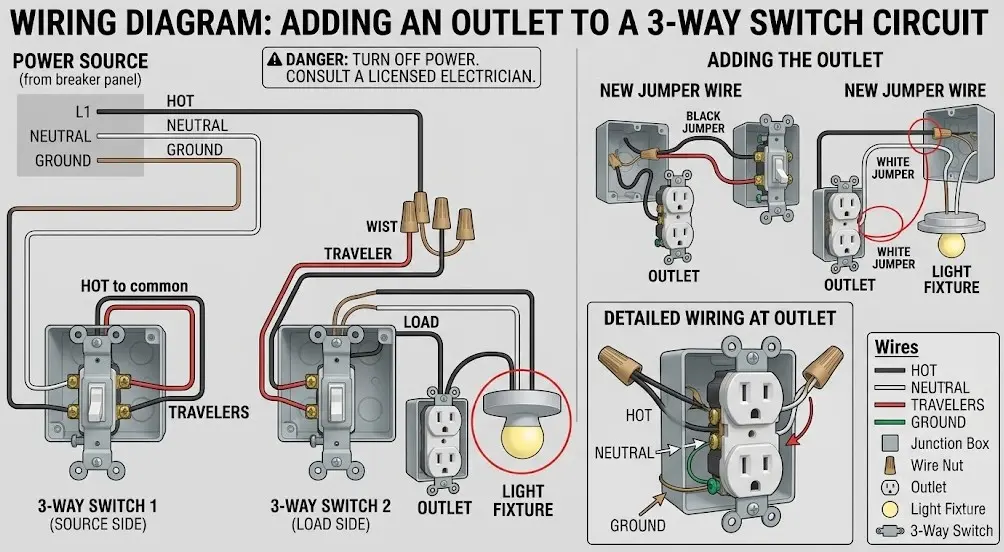
Adding an electrical outlet near an existing 3-way switch can be useful, but it is not as simple as attaching a receptacle to any available wires in the switch box. The circuit configuration determines whether the box contains the hot, neutral, and ground conductors needed for a receptacle. Always de-energize and verify the circuit before electrical work, and follow applicable electrical codes.
If you are not comfortable identifying electrical conductors or determining circuit configuration, hiring a qualified electrician is the safer option.
What Is a 3-Way Switch Circuit?
A 3-way switch circuit allows one light or other electrical load to be controlled from two different locations. Unlike a standard single-pole switch, a 3-way switch has a common terminal and two traveler terminals.
Understanding those conductors is essential before attempting to add an outlet.
How does a 3-way switch work?
A typical 3-way arrangement contains two switches connected by traveler conductors. Depending on the position of the switches, electrical power is directed through one traveler or the other to control the connected light or load.
The important components include:
- Common terminal: The terminal used for the incoming line or outgoing switched connection, depending on the switch’s location in the circuit.
- Traveler terminals: The two terminals used to connect the switches together.
- Neutral conductor: Provides the return path for many electrical loads and is generally required for a conventional receptacle.
- Grounding conductor: Provides a path for fault current and helps protect against electrical shock.
A major difference from a single-pole switch is that a 3-way switch does not simply have one incoming hot and one outgoing switched wire. Its configuration depends on where power enters the circuit and where the load is located.
What wires are typically found in a 3-way switch box?
Depending on the wiring method, you may find:
- Line or hot conductor
- Switched conductor
- Two travelers
- Neutral, if present
- Grounding conductor
The exact arrangement can vary significantly, particularly in older homes or installations that have been modified.
That is why wire color alone should never be used to determine what a conductor does. A white conductor, for example, is not automatically proof that a usable neutral is present.
How to Wire an Outlet Off a 3-Way Switch: What Has to Be Present?
The key question is not simply whether a 3-way switch is nearby. The important question is whether the electrical box contains the conductors and circuit conditions necessary for the new receptacle.
Does a 3-way switch box always have a neutral?
No.
Some 3-way switch boxes contain a neutral conductor, while others do not. The wiring method used for the original installation determines which conductors are present in the box.
This matters because a conventional receptacle generally requires an appropriate hot, neutral, and grounding connection. If the neutral is located at another box or at the light fixture rather than the switch, simply adding an outlet at the switch location may not be possible without changing the wiring.
Do you need a constant hot for an outlet?
Usually, you need to determine whether you want the receptacle to be always powered or controlled by the switch.
A constant hot remains energized regardless of whether the light is on. A switched conductor receives power only under certain switch positions.
If an outlet is unintentionally connected to a switched conductor, you may discover that the receptacle only works when the associated light is switched on.
For most general-purpose outlets, an always-powered configuration is more practical.
What role does the ground wire play?
The grounding conductor is an important safety component, but it is not a replacement for a neutral.
The neutral and grounding systems perform different functions. Connecting a receptacle between hot and ground in an attempt to substitute for a missing neutral is unsafe and should not be used as a workaround.
Can You Add an Outlet From Any 3-Way Switch?
Not necessarily.
A switch box may be a suitable location if it has:
- An appropriate line/hot conductor
- A usable neutral where required
- A grounding conductor
- Adequate box capacity
- An appropriate circuit
- Wiring in good condition
- Sufficient circuit capacity for the intended load
On the other hand, the project may require additional electrical work if:
- No neutral is available
- Only switched power is present
- Wiring is damaged or deteriorated
- Aluminum wiring is present
- The circuit is overloaded
- The box is already overcrowded
- Multiple circuits are unexpectedly present
- The existing installation has code or safety concerns
This is one reason an electrical box should not be treated as though every 3-way switch has the same wiring arrangement.
Understanding the Main Wiring Configurations
Configuration 1: Power enters at the switch box
In some installations, the incoming electrical supply reaches one of the switch boxes before continuing through the switching arrangement.
Depending on the specific configuration, this may mean the box contains more of the conductors required for an additional receptacle.
However, the actual conductors still need to be correctly identified. The presence of several wires does not automatically mean that a suitable neutral and constant hot are available.
Configuration 2: Power enters at the light fixture
In another arrangement, the incoming power may reach the light fixture first.
In that situation, the switch box may not contain a neutral conductor. This can make adding a conventional outlet at the switch location considerably more complicated.
Configuration 3: Power and switching conductors are distributed between boxes
Some installations use wiring arrangements in which the supply, switches, and load are connected across multiple boxes.
In these situations, wire count is not enough to identify the circuit. Each conductor needs to be understood in the context of the complete circuit.
How to Identify the Wires Before Adding an Outlet
Before considering any connections, determine what circuit you are actually working with.
Identify the circuit breaker
Determine which breaker supplies the switch and associated light.
Do not assume that the nearest breaker is the correct one. Electrical panels and circuits can be configured in ways that are not obvious from room layout alone.
Turn off the circuit
Switch off the appropriate breaker before opening or working on the electrical box.
For situations where other people could restore power, appropriate lockout or warning procedures can help prevent accidental energization.
Verify that power is actually off
Turning off a breaker is not the same as proving that a conductor is de-energized.
Use an appropriate electrical tester to verify the absence of voltage before handling conductors. A non-contact voltage tester can be useful as one part of the process, but it should not be treated as the sole proof that a circuit is safe to touch.
If you still detect voltage or cannot confidently determine what is energized, stop.
Trace and identify conductors
Determine which conductors serve as:
- Line/hot
- Load or switched conductor
- Travelers
- Neutral
- Ground
Do not identify them simply by assuming their colors or positions.
Check the electrical box
Adding a receptacle can change the box-fill requirements because the box may need to accommodate the device and conductors associated with it.
An existing switch box that was adequate for its original configuration may not necessarily be large enough for an additional receptacle.
How to Wire an Outlet Off a 3-Way Switch Step by Step
Electrical safety note: Electrical work can result in electric shock, arc flash, fire, or property damage. The steps below are intended to explain the planning and decision-making involved, not to replace an electrician’s evaluation of an unfamiliar circuit.
Step 1: Determine whether the circuit is suitable
First determine:
- How the 3-way circuit is configured
- Where power enters the circuit
- Whether a neutral is available
- Whether an appropriate constant hot is available
- Whether a ground is present
- What load the new receptacle will serve
A receptacle intended for a phone charger is very different from one intended to supply a space heater or other high-wattage appliance.
Step 2: Shut off power at the breaker
Turn off the breaker supplying the circuit.
Never assume that turning off the wall switch makes the electrical box safe. A switch can interrupt one conductor while other conductors in the box remain energized.
Step 3: Verify de-energization
Test the conductors before touching them.
If the expected voltage is still present, stop and determine why. An unexpected reading can indicate that the wrong breaker was turned off or that multiple circuits are involved.
Step 4: Identify the line, neutral, travelers, and ground
The exact function of each conductor should be established before any connection is changed.
Do not automatically treat a white wire as a neutral or a black wire as a particular circuit function. Older wiring and modified installations can produce exceptions.
Step 5: Decide whether the outlet should be always powered or switched
For most general-use receptacles, an always-powered outlet is preferable.
A switched outlet can make sense for specific applications, such as controlling a lamp, but it can be inconvenient if you expect the receptacle to power devices independently of the room’s lighting.
Step 6: Confirm receptacle and circuit requirements
The receptacle needs to be appropriate for the circuit and installation location.
Consider:
- Receptacle rating
- Circuit rating
- GFCI protection where required
- AFCI protection where required
- Circuit capacity
- Location-specific requirements
- Applicable local electrical code
A receptacle should not simply be added because there is physical space in the electrical box.
Step 7: Make connections according to the verified circuit configuration
There is no universal wire-to-terminal recipe for every 3-way switch circuit.
The correct arrangement depends on where the line, load, travelers, neutral, and ground are located.
The important principle is to maintain the intended 3-way switching configuration while providing the receptacle with its required conductors.
If you cannot confidently determine the circuit from the existing wiring and an appropriate wiring diagram, this is the point to stop and obtain professional assistance.
Step 8: Secure the conductors and device
Connections should be properly contained within the electrical box, with no exposed or loose conductors.
The receptacle and cover should be securely installed and the box should not be overcrowded.
Step 9: Restore power and test
Once the installation has been completed and the box is properly closed, restore power.
Test:
- The new receptacle
- Both 3-way switch locations
- The intended operation of the light
- Any applicable GFCI protection
If the breaker immediately trips or the circuit behaves unexpectedly, turn it off and investigate the cause rather than repeatedly resetting it.
Always-Powered Outlet vs. Switched Outlet
| Outlet Configuration | How It Behaves | Advantages | Drawbacks | Best Use |
|---|---|---|---|---|
| Always-powered outlet | Remains energized regardless of light | Convenient for most devices | Requires appropriate constant power | General receptacle use |
| Switched outlet | Controlled by the switch | Useful for selected loads | Turns off with switch | Lamps or specific applications |
| GFCI-protected outlet | Provides ground-fault protection where required | Increased protection from ground-fault hazards | Requires testing/resetting | Applicable locations |
| AFCI-protected circuit | Helps protect against certain arc-fault conditions | Additional fire protection | Requirements depend on location/code | Where required |
What Happens If There Is No Neutral in the 3-Way Switch Box?
This is one of the most important limitations to understand.
If the switch box does not contain a suitable neutral, you generally cannot simply connect a conventional receptacle between the hot conductor and ground.
The grounding conductor cannot be used as a substitute for the neutral.
Depending on the home’s wiring configuration, the solution could involve bringing an appropriate conductor to the box, modifying the circuit, or choosing a different location for the receptacle.
That can turn what initially appears to be a small outlet installation into a larger electrical project.
Can You Add an Outlet to a 3-Way Switch Without Changing the Switch?
Potentially.
The existing 3-way switches may not need to be replaced if the electrical box already contains the necessary conductors and the circuit is otherwise suitable.
However, modifications may be necessary if:
- The neutral is absent
- Only switched power is available
- The existing box is too small
- Wiring needs to be rerouted
- Circuit protection needs to be changed
- The existing wiring is damaged or outdated
The goal should be to preserve the correct 3-way operation while adding the receptacle safely.
Outlet Placement and Electrical Code Considerations
Electrical requirements vary depending on the location, circuit, building, and applicable code edition.
Receptacle location
The best location is not necessarily the closest point to the switch.
Consider:
- Accessibility
- Intended use
- Furniture placement
- Cord routing
- Wall space
- Other electrical devices nearby
GFCI protection
GFCI protection may be required for receptacles in certain locations, including some kitchens, bathrooms, garages, outdoor areas, and other locations exposed to moisture.
Requirements can vary, so verify the rules applicable to the specific installation.
AFCI protection
AFCI requirements apply to certain residential circuits and locations under applicable electrical codes.
If the addition or modification changes the circuit in a way that affects protection requirements, those requirements should be evaluated before the work begins.
Circuit capacity
Adding a receptacle does not automatically mean the circuit can safely power an additional high-demand appliance.
A circuit that currently supplies lighting and small loads may not be appropriate for a space heater, large appliance, or other substantial electrical load.
Box-fill requirements
The number and size of conductors and devices inside an electrical box affect the required box volume.
Adding a receptacle can therefore make an existing switch box inadequate even if the new device physically appears to fit.
Common Mistakes When Wiring an Outlet From a 3-Way Switch
Assuming every 3-way switch box contains a neutral
This is one of the most common misunderstandings.
The switch box may contain travelers and switched conductors without providing the neutral required for a conventional receptacle.
Using the ground as a neutral
Never use the equipment grounding conductor as a substitute for a neutral.
They serve different purposes within the electrical system.
Connecting to the switched hot unintentionally
This can result in an outlet that only works when the associated light is turned on.
If the goal is a general-purpose receptacle, the circuit needs to be configured appropriately for continuous power.
Relying only on wire colors
Color conventions are useful, but they are not a substitute for actually identifying the circuit.
This is particularly important in older homes or circuits that have been modified.
Working without verifying that power is off
A wall switch being off does not prove that the electrical box is de-energized.
Always verify before handling conductors.
Ignoring box-fill requirements
An overcrowded electrical box can create installation and safety problems.
The box needs to be suitable for the number and size of conductors and devices installed inside it.
Adding a high-load appliance to a lighting circuit
A convenient outlet location does not necessarily mean the circuit has sufficient capacity.
Always consider the intended load before adding a receptacle.
Mixing incompatible wiring or devices
The receptacle, conductors, circuit protection, and installation method must be compatible.
When an installation includes older wiring, unusual materials, or previous modifications, professional evaluation becomes especially important.
When Should You Call a Licensed Electrician?
Electrical work becomes significantly less suitable for DIY troubleshooting when you cannot confidently establish how the existing circuit is configured.
Consider calling a qualified electrician if:
- You cannot identify the conductors
- There is no neutral where one is required
- Wiring is old or damaged
- You find aluminum wiring
- Voltage readings are unexpected
- Multiple circuits appear to enter the box
- The electrical box is overcrowded
- Wiring must be routed through walls
- Circuit protection needs modification
- The receptacle will power a high-load appliance
- You are uncertain about code compliance
A professional can evaluate the complete circuit rather than treating the switch box as an isolated collection of wires.
For homeowners in the Virginia Beach area who need electrical work as part of a larger renovation, GSS757 provides remodeling and electrical/lighting services, including kitchen remodeling and broader home renovation projects. Their team combines remodeling and electrical capabilities, which can be particularly useful when an outlet addition is part of a larger renovation rather than a standalone repair.
This is also where a small electrical modification can become part of a broader home remodeling in Virginia Beach, for example, when new outlets are needed alongside lighting, cabinetry, kitchen layout changes, or other renovations.
Troubleshooting: Why Isn’t the New Outlet Working?
The outlet has no power
Possible causes include:
- Tripped circuit breaker
- Tripped GFCI device
- Incorrect circuit identification
- Incorrect wiring configuration
- Loose connection
Do not repeatedly reset a breaker that trips.
The outlet works only when the light is on
This commonly points to the receptacle receiving switched rather than constant power.
The circuit configuration should be reviewed rather than assuming the receptacle itself is defective.
The 3-way switches no longer work correctly
Changing wiring in a 3-way circuit can affect the relationship between the common and traveler conductors.
If the switches no longer control the light correctly, stop and re-establish the circuit configuration rather than guessing at terminal connections.
The breaker trips immediately
An immediate trip can indicate a short circuit, wiring error, overload, or another electrical problem.
Turn the circuit off and investigate the cause. If you cannot confidently identify the problem, professional diagnosis is appropriate.
FAQs About How to Wire an Outlet Off a 3-Way Switch
1. How do you wire an outlet off a 3-way switch?
It depends on the specific 3-way circuit configuration. A conventional receptacle generally needs an appropriate hot, neutral, and ground. Because not every 3-way switch box contains those conductors, the existing wiring must be identified before making any changes.
2. Can you add an outlet to a 3-way switch?
Yes, some 3-way circuits can accommodate an additional outlet. However, the switch box must contain the appropriate conductors and have adequate box and circuit capacity.
3. Does a 3-way switch have a neutral wire?
Not necessarily. Some 3-way switch boxes contain a neutral while others do not. The wiring method determines which conductors are available.
4. Can I use the ground wire instead of a neutral for an outlet?
No. A grounding conductor should never be used as a substitute for a neutral conductor. They perform different functions and should remain properly separated.
5. Why does my new outlet only work when the light is on?
The outlet may be connected to a switched conductor instead of a constant hot. The circuit should be identified to determine whether the receptacle is receiving switched or continuous power.
6. Can I add an outlet without changing the 3-way switch?
Potentially. If the existing box contains the appropriate hot, neutral, and ground and has sufficient capacity, the 3-way switches may not need to be replaced. The actual circuit configuration must be evaluated first.
7. Can I add a GFCI outlet to a 3-way switch circuit?
Potentially, depending on the circuit and installation location. GFCI requirements depend on where the receptacle is installed and the applicable electrical requirements.
8. Why does my breaker trip after adding the outlet?
A tripping breaker can indicate a short circuit, wiring error, overload, or another electrical problem. Turn the circuit off and determine the cause instead of repeatedly resetting the breaker.
9. How do I know which wire is the common wire on a 3-way switch?
The common terminal is normally distinguished from the two traveler terminals on the switch. However, conductor colors and previous wiring modifications can vary, so identification should be based on the actual device and circuit rather than assumptions.
10. Is it safe to wire an outlet from a light switch?
It can be safe when the circuit is properly configured, the appropriate conductors are available, the circuit has sufficient capacity, and the installation meets applicable electrical requirements. If the wiring is unfamiliar or questionable, professional evaluation is the safer choice.
Conclusion: How to Wire an Outlet Off a 3-Way Switch
Learning how to wire an outlet off a 3-way switch starts with understanding that there is no universal wiring arrangement for every 3-way switch box.
The critical issue is determining what conductors are actually available. A conventional receptacle generally needs an appropriate hot, neutral, and ground, while a 3-way switch circuit may also contain travelers and switched conductors that cannot simply be substituted for those connections.
Before modifying the circuit, identify the wiring configuration, turn off the appropriate breaker, verify that power is off, consider circuit capacity and box-fill requirements, and account for GFCI, AFCI, and other applicable requirements.
Most importantly, never use a ground as a neutral and never guess at the function of a conductor based solely on its color.
For straightforward installations with known wiring, adding a receptacle may be a manageable electrical project. But if the box lacks a neutral, contains damaged or unusual wiring, is overcrowded, or requires significant circuit modifications, bringing in a qualified electrician is the better approach.
The objective is not merely to make the new outlet work. It is to ensure that the entire electrical circuit remains safe, properly protected, and appropriate for the loads it will serve.